Disease, Illness and Death in the Papermaker’s Daughter: Childbed Fever, Ulcers and Lung Cancer
Warning: if you're a little on the squeamish side, you may find some of this content disturbing.
There are several characters in The Papermaker’s Daughter who have to put up with illness and it goes without saying that conditions were not as sanitary and treatments not as advanced as they are today.
SPOILER ALERT! Contains excerpts from the stories and plot reveals.
Childbed Fever (Puerperal Sepsis) in the 1880s
Elizabeth Crouch’s Deathbed
The second-to-last chapter of the novel opens with Elizabeth Crouch on her deathbed:
The doctor had diagnosed childbirth fever. A piece of the afterbirth festered in her womb and she would die within weeks if not days.
In the illustration, a woman is being shown her newborn baby for the final time before receiving the last rites.
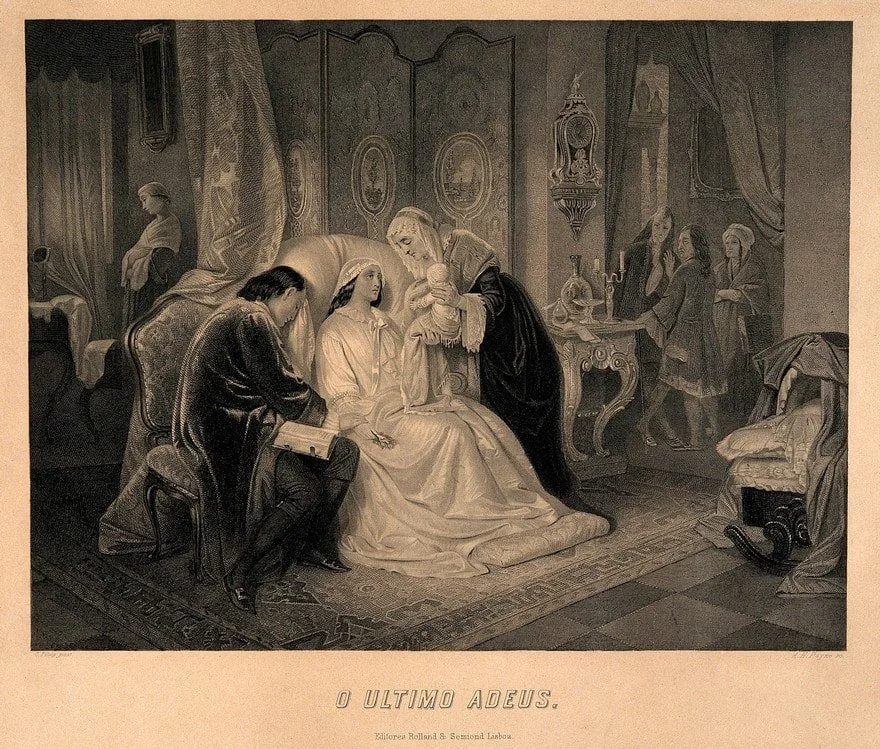
[Engraving by A.H.Payne after C.Piloty - Wellcome Collection.]
What Was Childbed Fever?
Known nowadays as puerperal sepsis, a term coined in 1716 by Edward Strother, childbed fever is an infection soon after childbirth caused by a streptococcus bacterium. The disease progresses rapidly with symptoms of abdominal pain, fever and weakness. Elizabeth knows she will die soon. She must put her affairs in order and write a letter to her daughter while she still has strength:
At present her symptoms were mild: headaches, a pain in her abdomen, fevers and chills, which woke her at night. But her condition would worsen.
The disease also affects lactation. Poor Elizabeth could not even nurse her newborn daughter:
She glanced at the crib next to her bed, expecting to see her precious baby asleep, but the wet-nurse had taken her. Elizabeth’s own milk had dried.
Why Was Childbed Fever So Common?
An understanding of infections and how they are transmitted was in its infancy towards the end of the 19th century. Childbed fever was widespread and feared. It was one of the many causes of death in childbirth. ‘In the 18th and 19th centuries, there were between six and nine cases for every 1,000 deliveries, resulting in a death toll during that span of as much as half a million in England alone.’ 1 [
Read more about child birth in the early 20th century.
In Elizabeth’s case it was caused by a torn placenta. The part of the placenta left in the uterus becomes infected a few days after the birth leading rapidly to blood poisoning. But childbed fever was often caused by lack of hygiene when doctors or midwives failed to wash their hands and unwittingly passed on infection from one patient to another. A doctor could come directly from examining a body in the morgue to attending a mother in childbirth without washing his hands. Statistically, you were more likely to get childbed fever from a doctor assisting the birth than a midwife.
How Was Childbed Fever Treated?
In Elizabeth’s day, 1881, there was no known cure and death was almost inevitable. Treatment included opium for the pain and bloodletting to reduce the fever:
Elizabeth reclined in the chair and closed her eyes, steadying her breathing as the dull pain in her abdomen intensified into something she could no longer ignore. Her forehead felt hot to her touch. Time for more bloodletting soon.
But there was no treatment available to kill the bacteria which caused the infection. With modern hygiene and antibiotics, thankfully, the disease is now comparatively rare
Duodenal Ulcers in Victorian Times
Duodenal ulcer - George Crouch
Elizabeth meets her future husband, George Crouch at her father’s surgery in Sandwich.
This was not their first meeting. Every month for the last six months, she had ushered him into Papa’s surgery.
Elizabeth’s father is a doctor specialising in ailments of the digestive tract.
Papa’s reputation for curing intractable complaints of the digestive system, which drew patients from far and wide, had led her to make a second deduction concerning Mr Crouch. If he can afford to travel here and pay your fees, he must be wealthy.’
Elizabeth is concerned to know what is the matter with her suitor. Her sister Susan is also keen to know all the details:
‘What’s wrong with him?’ The eagerness for gossip-worthy details sounded in Susan’s voice.
Now, now,’ Papa said. ‘Remember what I’ve taught you concerning patient confidentiality?’
‘Well,’ Elizabeth said, ‘I’d like to know if his condition is serious before I take his courtship seriously.’
Papa assures Elizabeth that Mr Crouch is cured but she still has her doubts the following Sunday when he comes to tea:
Mrs Brown brought in a plate of soft cod roe on buttered toast. Mr Crouch consumed a single slice. Did such restraint arise from his character or his medical condition?.
Symptoms and Treatment of Duodenal Ulcers
George has been suffering from a duodenal ulcer, another disease caused by bacteria, though not usually fatal. The symptoms include abdominal pain a few hours after eating and at night, bloating, blood in the faeces, sometimes nausea or vomiting.
Nowadays duodenal ulcers can be investigated by endoscopy and treated with a range of sophisticated drugs but in the 1880s the treatment was confined to dietary advice and the use of antacids such as milk of magnesia.
Drinking alcohol exacerbates the condition. As Elizabeth discovers after she is married, George often enjoys a drink too many.
A Growth on the Lungs: Lung Cancer in 1919
George Crouch’s Final Illness
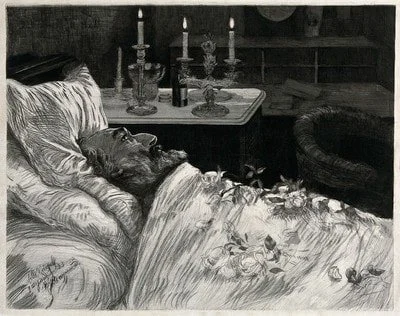
George recovers from his ulcer and lives to a ripe old age before dying of lung cancer. His daughter, Sarah, and he are estranged and she hears the news of his illness from a sister-in-law she bumps into in the town:
’I met my sister-in-law in town, my brother Walter’s wife, and she said my father’s seriously ill. They’ve moved into the cottage to care for him. They don’t think he’s got much time left.’
Since he’s clearly on his last legs, Sarah decides to visit him at his cottage where his son Harry greets her:
‘How is he?’
‘His breathing’s not up to much,’ Harry replies. ‘A growth on the lungs, the doctor reckons. But you know Father—he’s a tough old boot.’
‘Is he in pain?’
‘The laudanum sees to that, but it makes him drowsy. He’s due another dose soon. Go up now, if you want any sense from him.’
Even before entering the bedroom, I hear his laboured breathing, like a saw rasping through hard wood. The drawn curtains and a fire in the grate make the sickroom dim and stuffy, permeated by a whiff of ammonia from the chamber pot. Father is sitting in an armchair, a blanket over his knees, chin on chest.
‘Hello, it’s Sarah. I heard you’re unwell. How are you feeling?’
With an effort, he lifts his head and surveys me with his rheumy eyes.
George shows symptoms of advanced lung cancer – wheezing, shortness of breath and fatigue:
My visit has exhausted him. His chest heaves as he struggles to fill his lungs. He draws in just enough air to speak again.
‘Leave. Don’t want you…stirring memories.’
I, too, want to get away.
How Was Cancer Treated in 1919?
Obviously, modern treatments of chemotherapy were unavailable in 1904 when George was suffering from this disease. They were developed in the 1940s. Radiotherapy was begun in 1900 but was not widespread until mid-century. Surgery to remove a tumour was one option. Although anaesthetics, introduced in the 1840s, meant surgery was less painful, most patients were not cured by it.
For George, opiates to dull the pain were the only treatment. He dies a couple of months later after a final confrontation with his daughter.
Enough of this gruesome topic for the time being. Good health to you all!
Adrienne.
Footnote: 1. Emily Baumrin, William Corbett, and Amita Kulkarni, Dartmouth Medical School, 2010
Sources:
1.The Attempt to Understand Puerperal Fever in the Eighteenth and Early Nineteenth Centuries by Christine Hallett PhD.
2. Childbed fever: A Nineteenth-Century Mystery by Christa Colyer School of Science University of Ontario Institute of Technology
3. A comprehensive history of cancer treatment by Nigel Hawkes.
related blog posts